
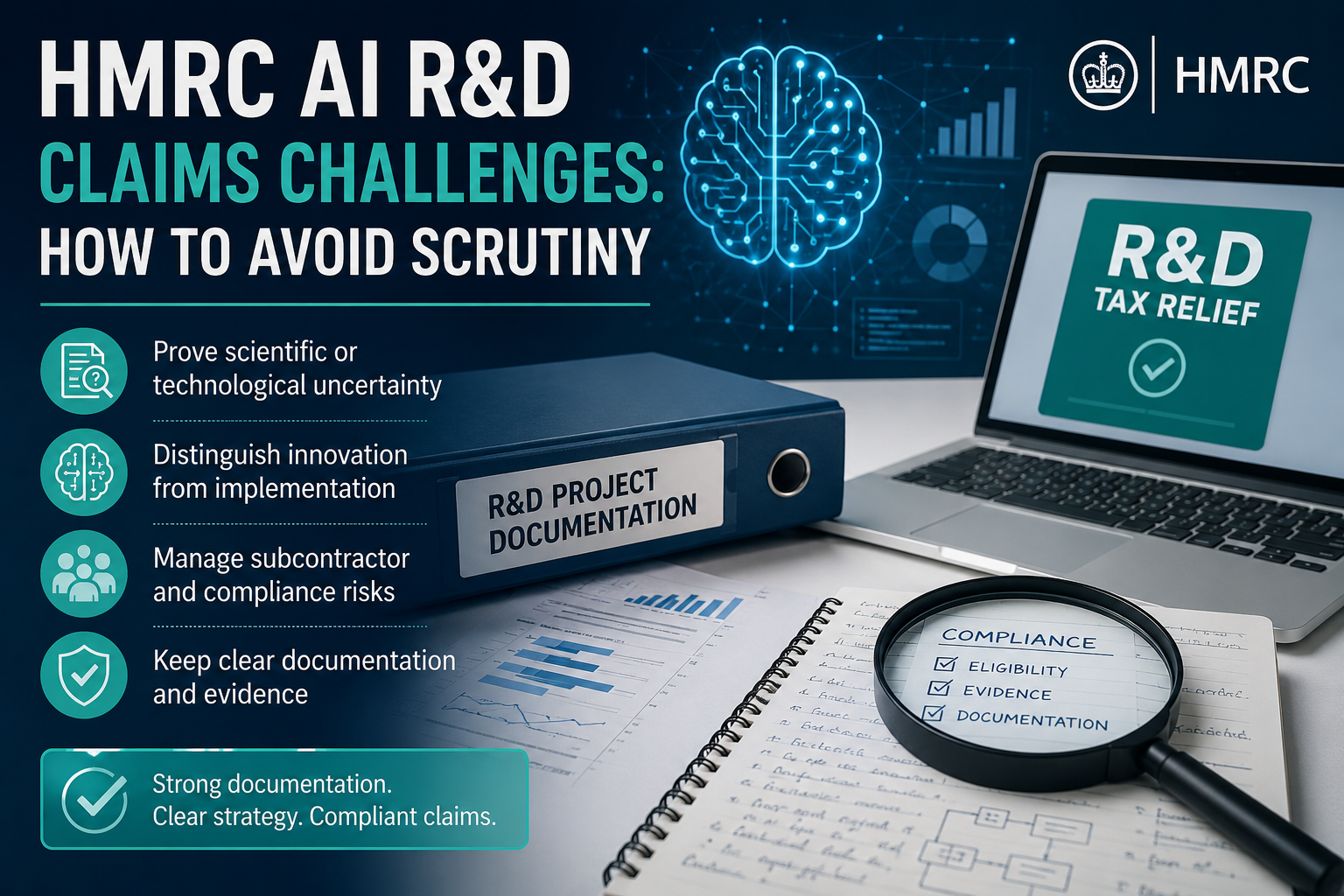
Claiming Research and Development (R&D) tax relief is a valuable opportunity for UK businesses. But when your project involves artificial intelligence, the process comes with a unique set of hurdles. HMRC has become enormously stricter in current years, and AI-associated claims are beneath closer scrutiny than ever.
If your business is running on system getting to know models, herbal language processing, computer imaginative and prescient, or any AI-pushed generation, information those demanding situations could prevent from a luxurious compliance mistake.
Why HMRC Is Paying Close Attention to AI Claims
AI has become one of the most popular areas for R&D tax credit score claims in the uk. That surge in hobby has induced HMRC to use greater oversight. Many claims are being flagged for enquiry because they lack technical depth or do not clearly meet the qualifying criteria.
The core problem is that this: no longer every AI challenge qualifies as R&D beneath HMRC’s definition. The interest should seek to acquire an improve in science or era through resolving clinical or technological uncertainty. in reality using current AI gear or frameworks does no longer qualify, no matter how state-of-the-art the output seems.
Common Challenges When Claiming R&D for AI Projects
1. Proving Scientific or Technological Uncertainty
This is the most significant barrier for AI claims. HMRC requires businesses to demonstrate that, at the start of the project, a competent professional in the field could not have easily worked out how to achieve the intended advance.
With AI, this is tricky because:
- Many device getting to know techniques are well-documented and widely available.
- Pre-educated fashions (like GPT-primarily based architectures or general neural networks) exist already.
- Applying existing algorithms to a new commercial enterprise hassle is not the same as advancing the technology itself.
What allows: Detailed technical documentation displaying in which your group encountered real unknowns, what experiments had been run, and how outcomes had been unsure during.
2. Distinguishing Innovation from Implementation
A very common reason AI claims are rejected or reduced is the confusion between innovating technology and implementing it.
| Activity | Likely Qualifies | Unlikely Qualifies |
|---|---|---|
| Developing a novel training method | ✅ Yes | |
| Fine-tuning a pre-trained model for internal use | ❌ No | |
| Solving a new AI architecture challenge | ✅ Yes | |
| Integrating an existing AI API into your product | ❌ No | |
| Researching how to reduce AI model hallucinations | ✅ Yes | |
| Deploying a chatbot using off-the-shelf tools | ❌ No |
The distinction matters enormously. HMRC officers reviewing your claim will look for evidence that you were not simply using a tool someone else built.
3. Subcontractor and Externally Provided Workers
AI development often involves freelancers, data scientists, or specialist agencies. HMRC has tightened the rules here significantly. Under the merged R&D scheme (which took effect from April 2024), the treatment of subcontractor costs has changed.
Key points to be aware of:
- Costs for overseas subcontractors may no longer be claimable in the same way
- Arrangements must be carefully documented to show the claimant company is bearing the risk and directing the R&D
- HMRC may challenge whether the intellectual property genuinely sits with your business
4. The “Routine Analysis” Trap
One area that trips up many AI companies is data processing. Training an AI model involves enormous amounts of data work — but HMRC does not consider routine data collection, cleaning, and preparation as qualifying R&D activity.
Only the work directly connected to resolving the technological uncertainty qualifies. This means you need to carefully separate qualifying hours from non-qualifying ones when preparing your claim.
5. HMRC Enquiries and the Compliance Checks Process
AI claims are disproportionately selected for compliance checks. If HMRC opens an enquiry into your claim, here is what typically happens:
- Initial contact — HMRC sends a letter requesting more information about the technical nature of your project
- Information requests — You may be asked to provide technical reports, project timelines, employee records, and financial breakdowns
- Technical review — HMRC may involve its own technical advisors to assess whether the work genuinely advances the field
- Outcome — Claims can be general, reduced, or rejected; consequences can practice if HMRC believes the claim become negligently or fraudulently made
This manner can take months and is aid-in depth. Having strong documentation from the outset is your best protection.
How to Strengthen Your AI R&D Claim
Getting your declare proper from the beginning is far less difficult than protecting a susceptible one. right here are practical steps to comply with:
- Write a detailed technical narrative — Provide an explanation for the medical or technological uncertainty in undeniable phrases, what your crew tried, what failed, and what became finally resolved
- Keep contemporaneous records — Timesheets, experiment logs, version control commits, and internal reports all help evidence qualifying activity
- Separate qualifying work clearly — Not all of a data scientist’s time qualifies; distinguish R&D activity from routine work
- Use a qualified adviser — R&D tax specialists with experience in AI claims understand what HMRC looks for and can frame technical work in the right language
- Review subcontractor contracts — Ensure they reflect that your company owns the R&D risk and outcomes
Recent Changes That Affect AI Claims
The landscape for R&D relief changed significantly in 2023 and 2024:
- The merged R&D scheme replaced the previous SME and RDEC schemes for most companies from April 2024
- Data and cloud computing costs became qualifying expenditure, which is particularly relevant for AI businesses training large models
- Additional information forms (AIFs) are now mandatory before submitting any R&D claim — this requirement alone has caught many businesses off guard
- HMRC has accelerated its funding in specialist R&D compliance teams focused on tech and AI sectors
Frequently Asked Questions
Does using ChatGPT or other AI tools in my business qualify for R&D tax relief?
No. the usage of present AI gear to improve enterprise strategies does no longer qualify. The relief is for developing new AI technology, not deploying it.
Can a startup with no profits claim R&D tax relief?
Under the merged scheme, loss-making SMEs may still access an enhanced credit rate or receive a payable tax credit in some circumstances. A tax adviser can assess your specific situation.
What is the Additional Information Form (AIF)?
It is a mandatory form introduced by HMRC that must be submitted before filing an R&D claim.It calls for special challenge descriptions and monetary information. Failing to submit it may invalidate your claim.
How far back can I amend an R&D claim?
Commonly, you could amend a enterprise tax go back up to two years after the quit of the accounting duration. Claims out of doors this window are commonly not prevalent.
Does HMRC have AI-specific guidance?
HMRC follows the general R&D guidelines set out in the BEIS framework. There is no separate AI-specific guidance, but the standard criteria apply fully — and HMRC applies them rigorously to AI claims.
Conclusion
Claiming R&D tax remedy for AI projects is without a doubt worthwhile, but it requires care and precision. HMRC has raised the bar notably, and AI-related claims face extra scrutiny than most. The groups that be successful are people who apprehend the qualifying criteria deeply, file their work fastidiously, and have interaction with the process proactively.
If your corporation is making an investment in artificial intelligence research and development, the tax benefits may be sizable. But cutting corners on your claim — or leaning on vague technical descriptions — is a risk not worth taking. Strong documentation, honest scoping, and professional advice are the foundations of a defensible and successful R&D claim.