
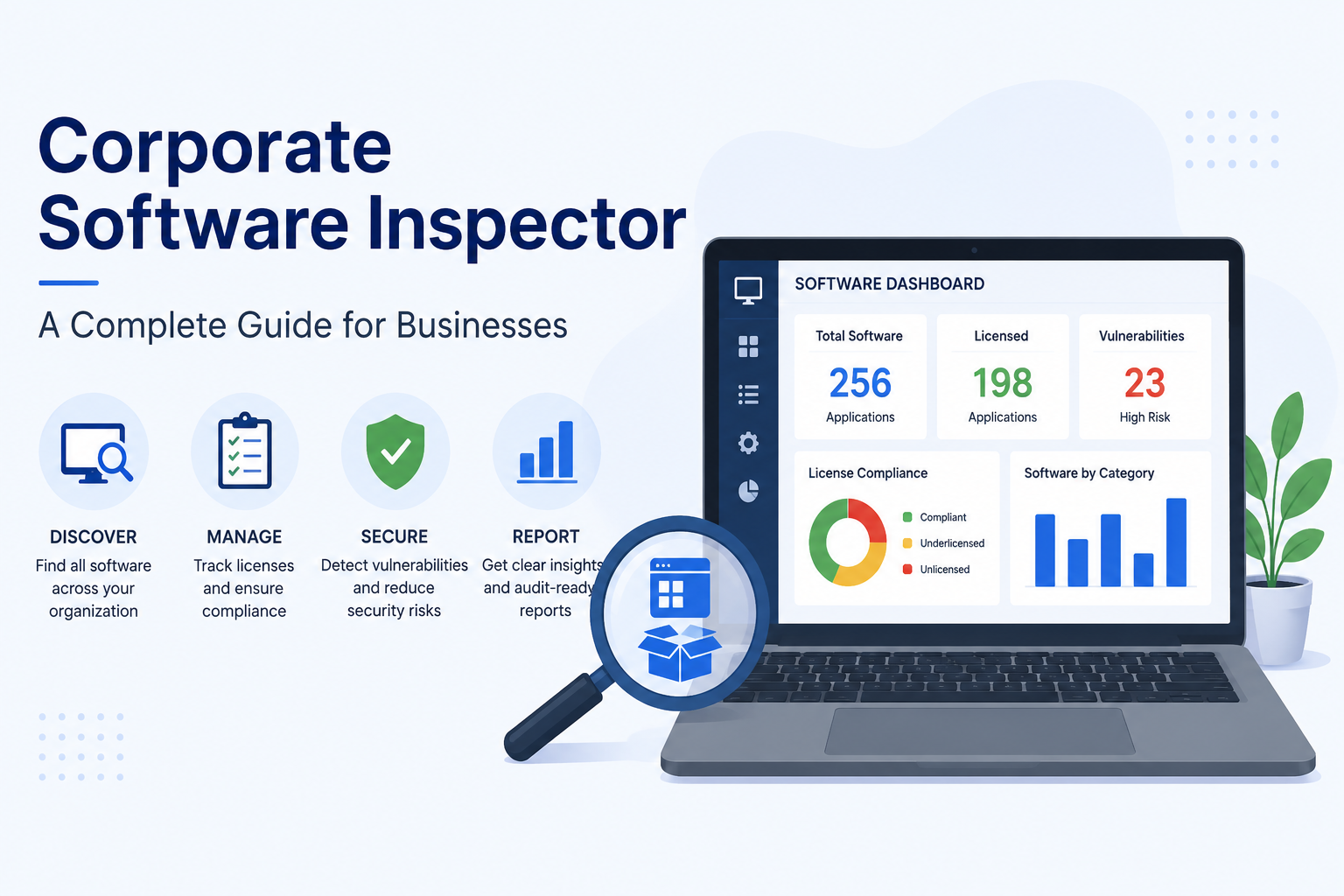
Every company today runs on software. From accounting equipment to design apps, employees use dozens of programs every day. However right here’s the hassle: most companies do not actually recognise everything it is installed throughout their structures. a few apps are old.
There is where corporate software inspector comes in. It helps businesses see, control, and comfy each piece of software program running across their community, without counting on guide checklists or guesswork.
In this article, we will give an explanation for what a corporate software program inspector is, the way it works, why it matters, and a way to pick out the proper one on your commercial enterprise.
What Is a Corporate Software Inspector?
A corporat software inspector is a device (or in some cases, a devoted professional) that scans, audits, and video display units all the software program installed across an organization’s computers, servers, and cloud bills.
Think about it as a virtual stocktaking system for software. instead of manually checking each pc and server, the inspector mechanically unearths out:
- What software is installed, and on which devices
- Whether each application is properly licensed
- Whether any software has known security weaknesses
- Whether unauthorized or unknown programs (often called “shadow IT”) are present
Some well-known platforms in this category, such as Flexera’s Software Vulnerability Manager (formerly called Corporate Software Inspector), combine all of this into one system that scans, detects, and even helps fix problems automatically.
Why Businesses Need Software Inspection
It’s easy to assume that software troubles are “just an IT problem.” In reality, they affect the whole commercial enterprise, along with legal risk, price range, and purchaser believe.
Here’s why software inspection has become so important:
- Security threats are rising. Attackers regularly target old, unpatched applications as opposed to operating structures, which can be generally properly maintained.
- Compliance rules are stricter.Guidelines like GDPR, HIPAA, and ISO 27001 require companies to expose they control software program software risk properly.
- License violations are costly. Using more software seats than you’ve paid for can lead to legal penalties during vendor audits.
- Shadow IT is common. Employees frequently deploy apps or browser extensions without telling IT, developing blind spots in protection.
- Manual tracking doesn’t scale. Spreadsheets work for ten computers, not for a thousand.
A corporate software inspector solves these problems by giving IT teams one clear, constantly updated view of the entire software environment.
How a Corporate Software Inspector Works
While different tools vary in detail, most follow a similar four-step process.
1: Discovery
The tool scans all connected gadgets, which may additionally consist of computers, laptops, servers, and cloud debts, to locate each set up application. that is typically performed thru light-weight dealers hooked up on every tool, network scans, or direct integration with cloud systems.
2: Inventory and Categorization
Once software is discovered, the system organizes the data. It records details such as:
- Application name and version
- Publisher information
- Installation date
- The device and user associated with each install
This step also cleans up inconsistent naming, because the equal utility might also appear below specific labels relying on the device or running device.
3: Risk and Compliance Analysis
Next, the inspector compares the software stock in opposition to regarded vulnerability databases (such as CVE listings) and license agreements. This reveals:
- Outdated or vulnerable applications
- Unauthorized or unapproved software
- License shortages or overuse
4: Reporting and Remediation
The system generates reports and alerts for IT groups. some superior tools circulate a step in addition thru routinely deploying patches or updates, then rescanning to confirm the restore worked.
Key Features to Look For
Not all software program inspection tools offer the identical depth. while evaluating one in your enterprise, search for those core capabilities:
- Automated, non-stop scanning as opposed to one-time manual assessments
- Broad application insurance, inclusive of third-party and non-Microsoft software program
- Vulnerability detection backed by a regularly updated database
- License and compliance tracking to avoid legal and financial risk
- Patch management integration, ideally connecting with tools you already use
- clear, exportable reviews for audits and management opinions
- Support for multipul systems, which include home windows, macOS, and Linux
Benefits of Using a Corporate Software Inspector
| Benefit | What It Means for Your Business |
|---|---|
| Stronger security | Vulnerable software is identified and patched before attackers can exploit it |
| Lower compliance risk | Easier to meet standards like GDPR, HIPAA, and ISO 27001 |
| Cost savings | Unused licenses and duplicate tools are identified and removed |
| Better visibility | IT teams know exactly what’s running across the organization |
| Faster audits | Ready-made reports save time during internal or external reviews |
| Reduced manual work | Automation replaces time-consuming spreadsheet tracking |
Manual Audits vs. Automated Software Inspection
Many smaller businesses still rely on manual software audits. While this can work for very small teams, it quickly becomes unmanageable as a company grows. Here’s how the two approaches compare:
| Factor | Manual Audit | Automated Inspector |
|---|---|---|
| Speed | Slow, takes days or weeks | Continuous, near real-time |
| Accuracy | Prone to human error | Consistent and data-driven |
| Scalability | Difficult beyond a few dozen devices | Works across thousands of endpoints |
| Vulnerability detection | Limited or absent | Built-in, updated regularly |
| Cost over time | Higher due to labor hours | Lower after initial setup |
| Audit readiness | Reports created manually | Reports generated automatically |
How to Implement a Corporate Software Inspector
If you’re planning to introduce software program inspection in your organisation, a established rollout allows keep away from disruption. here’s a simple step-via-step approach:
- Define your goal. Determine whether your priority is security, license compliance, fee reduction, or all three.
- Set the scope. Choosewhich departments, gadgets, or cloud bills to encompass first.
- Choose the right tool. Match features to your goals and existing IT systems.
- Run a pilot scan. Check the device on one branch before a corporation-extensive rollout.
- Review the initial report. This usually reveals quick wins, such as unauthorized apps or unused licenses.
- Roll out company-wide. Expand scanning to all devices and cloud services.
- Set a review schedule. Deal with inspection as an ongoing method, no longer a one-time assignment.
- Train your IT team. Make certain workforce recognize the way to study reports and act on signs.
Common Challenges and How to Handle Them
Even a good tool comes with a learning curve. Common issues include:
- Integration difficulties with older legacy systems. Start with well-supported integrations before tackling niche tools.
- Database dependency. The tool’s usefulness depends on regular vulnerability updates, so make sure your network allows uninterrupted access to update servers.
- Device diversity. Environments with many operating systems need careful, staged testing before full deployment.
- Keeping up with regulations. Compliance rules change often, so reports and policies need periodic review.
FAQs
1. Is a corporate software inspector only for large companies?
No. while big businesses benefit the most because of complicated environments, even small and mid-sized businesses can use those equipment to keep away from licensing problems and reduce protection dangers.
2. Does it replace antivirus software?
No. Antivirus software program protects in opposition to energetic threats like malware. A software program inspector specializes in finding previous or unpatched packages earlier than they end up an access factor for attackers. the 2 work nicely together.
3. How often should software inspections run?
Ideally, scanning ought to be non-stop or scheduled at regular periods, including weekly, in preference to as a one-time annual check.
4. Can it detect software employees installed without permission?
Sure. this is one among its key makes use of. It enables discover “shadow IT,” meaning unapproved apps that employees install on their personal.
5. What happens after vulnerabilities are found?
Most equipment generate a document and advocate or mechanically install a patch. a few additionally rescan afterward to affirm the problem is resolved.
Conclusion
As companies rely greater closely on software program, maintaining tune of what is installed, whether it is certified, and whether it is comfy has end up important as opposed to non-obligatory. A company software program inspector gives groups the visibility they want to manage this complexity with out drowning IT groups in manual paintings.
Whether your precedence is passing a compliance audit, cutting unnecessary software costs, or closing protection gaps earlier than attackers locate them, making an investment in proper software inspection is a sensible step in the direction of a more secure, more efficient IT environment.