
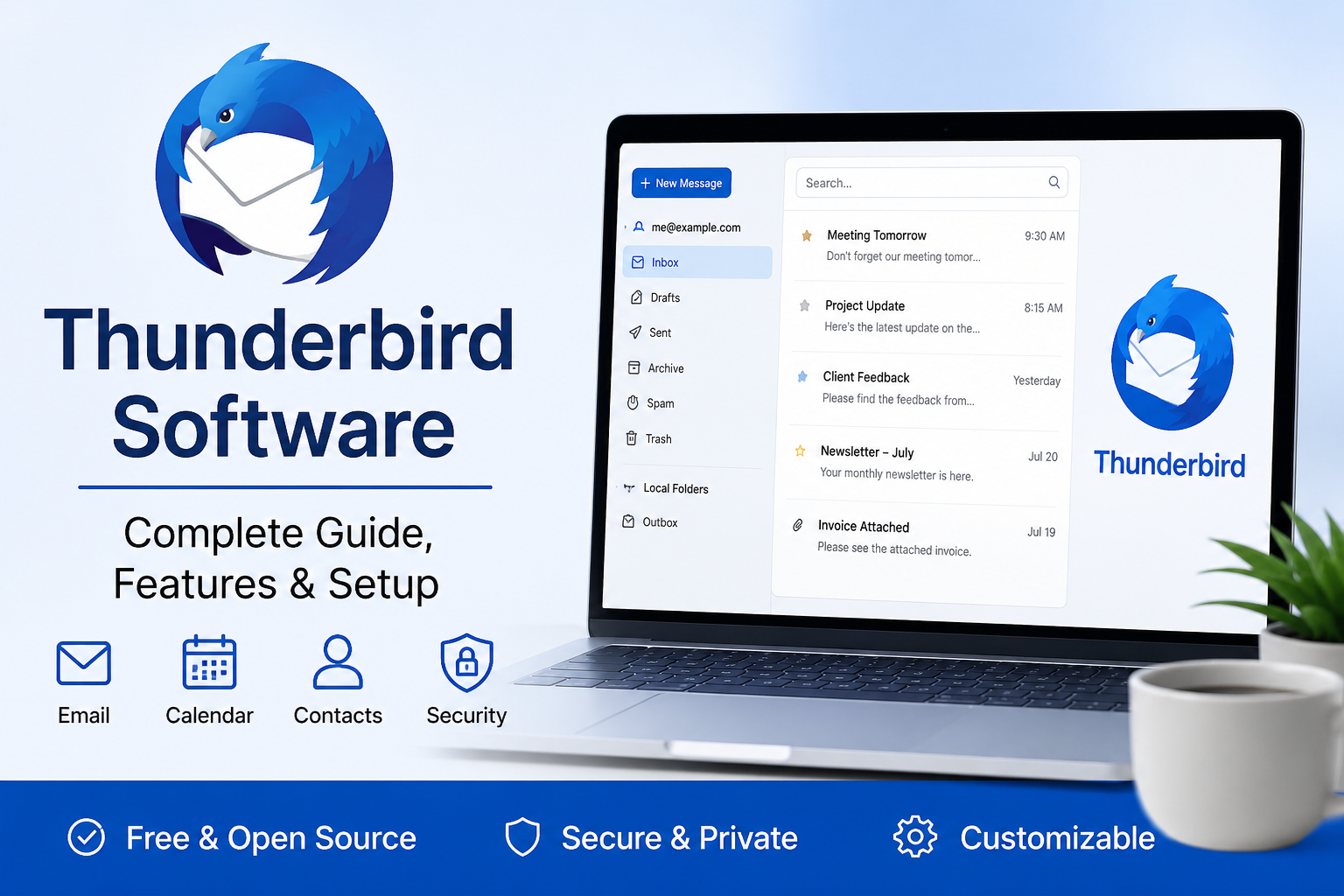
When you have ever felt uninterested in juggling more than one e mail accounts across distinct tabs, you are not by myself. I ran into the identical problems some years back even as dealing with 3 weeks inboxes and non-public ones. That’s after I switched to Thunderbird, and surely, it changed how I handle email every unmarried day.
In this article, i am able to walk you by the entirety about Thunderbird software – What it is, how it works, its features, and why so many human beings (including long-time IT experts) nonetheless trust it in 2026.
What Is Thunderbird Software?
Thunderbird is a free, open-supply email customer advanced with the useful resource of Mozilla, the identical corporation at the back of the Firefox browser. It helps you to manage multiple e mail bills, calendars, and contacts from one single computer software, in place of switching among browser tabs.
Unlike webmail offerings that force you to live logged right into a browser, Thunderbird runs immediately to your computer. this means:
- You can read old emails even without internet access
- Your data stays stored locally on your device
- You get more control over privacy and organization
It helps home windows, macOS, and Linux, so regardless of what gadget you use, Thunderbird fits right in.
Why People Still Choose Thunderbird in 2026
I have tested quite a few email clients over the years – Outlook, Spark, eM Client, and a couple of web-based tools. But Thunderbird keeps a loyal user base for a few solid reasons:
- It’s completely free – no subscription, no hidden charges
- No account limit – add as many email addresses as you want
- Strong privacy focus – Mozilla does not sell your data
- Accessories and topics – personalize it nearly like a browser
- Ordinary updates – the improvement group ships new features every few months
That last point matters a lot. A lot of “free” software gets abandoned after a while. Thunderbird isn’t one of them – it has been actively maintained for over two decades now.
Key Features of Thunderbird Software
Let’s break down the core features that make this tool worth installing.
1. Unified Inbox Management
You can connect Gmail, Outlook, Yahoo, or any IMAP/POP account and see all your messages sorted by folder, tag, or account – whichever way you prefer.
2. Built-in Calendar (Lightning)
Thunderbird comes with an integrated calendar feature. You can:
- Create events and reminders
- Sync with Google Calendar
- Share calendars with team members
3. Spam and Phishing Filters
It has a self-studying junk clear out. The greater you mark emails as unsolicited mail, the smarter it receives at catching comparable messages within the future.
4. End-to-End Encryption
Thunderbird helps OpenPGP encryption natively, with no need a separate plugin. That may be a massive deal for every person handling touchy company verbal exchange.
5. Tabbed Browsing for Emails
Similar to an internet browser, you could open a couple of emails in separate tabs instead of losing your region on every occasion you click on a new message.
6. Add-ons and Themes
There’s a whole marketplace of extensions – grammar checkers, quote-reply tools, dark mode themes, and more.
How to Set Up Thunderbird: Step-by-Step Guide
Setting it up is less complicated than the general public count on. Here’s how I generally do it whilst supporting someone install it for the first time:
- Download Thunderbird from the official Mozilla website (thunderbird.net)
- Install the application by running the setup file and following the on-screen prompts
- Open Thunderbird and click on “Set Up an Existing Email Account”
- Enter your name, email address, and password
- Thunderbird will auto-detect server settings for most popular providers
- Click “Done”, and your inbox will start syncing automatically
- Repeat the same steps to add more accounts if needed
A few minutes, all your emails, contacts, and folders will show up well organized.
Thunderbird vs Other Email Clients
Here is a short contrast desk that will help you recognize wherein Thunderbird stands towards different popular options.
| Feature | Thunderbird | Outlook | Gmail (Web) |
|---|---|---|---|
| Cost | Free | Paid (with Microsoft 365) | Free |
| Multiple account support | Yes, unlimited | Yes, limited on basic plans | Limited |
| Offline access | Yes | Yes | Limited |
| Built-in encryption | Yes (OpenPGP) | Requires add-on | No |
| Customization (themes/add-ons) | Extensive | Limited | Very limited |
| Open source | Yes | No | No |
| Calendar integration | Yes | Yes | Yes |
As you may see, Thunderbird holds its personal quite nicely, specifically if finances and privacy are priorities for you.
Common Problems Users Face
No software is best, and Thunderbird has its quirks too. Based totally on actual utilization, right here are some issues humans often run into:
- Slow performance with large inboxes
Fix: use the “Compact Folders” option regularly to clean up storage - Sync delays with Gmail
Fix: check your IMAP settings and make sure “Sync All Folders” is enabled - Add-ons stop working after updates
Fix: wait a few days for developers to release compatible versions, or check the Thunderbird Add-ons page for updated versions
I have individually faced the sync put off trouble after a chief replace, and sincerely re-checking the account settings solved it inside mins.
Who Should Use Thunderbird?
Thunderbird works best for:
- Freelancers managing multiple client email accounts
- Small business owners who want a free, secure email solution
- Privacy-conscious users who don’t want their data used for ad targeting
- IT teams looking for a customizable, open-source mail client
It won’t be the first-class healthy for individuals who want deep integration with Microsoft’s environment (like groups or SharePoint) – if so, Outlook may serve better.
Tips to Get the Most Out of Thunderbird
- Use folders and tags to prepare emails with the aid of project or precedence
- Activate message filters to auto-sort incoming mail
- Deploy a dark mode topic if you spend long hours reading emails
- Regularly lower back up your profile folder to keep away from dropping settings
- Discover the accessories manager for productiveness boosters like quick text templates
FAQs
Is Thunderbird software safe to use?
Yes. Thunderbird is developed by Mozilla, a famous and depended on organization. It does not promote person information and gives integrated encryption for added protection.
Is Thunderbird completely free?
Yes, Thunderbird is free and open-supply. There are not any top fee plans or hidden subscription costs.
Can I use Thunderbird with Gmail or Outlook accounts?
Absolutely. Thunderbird helps IMAP, POP3, and change bills, which means it really works easily with Gmail, Outlook, Yahoo, and maximum distinct agencies.
Does Thunderbird work offline?
sure, once your emails are synced, you could read and draft messages without an internet connection. they’ll ship automatically after you’re back on line.
Is Thunderbird available on mobile devices?
Thunderbird software isn’t flashy or ultra-modern, however this is exactly its electricity. It specializes in doing the fundamentals in reality properly – handling electronic mail, calendars, and contacts – without charging you a rupee or selling your information to advertisers.
Conclusion
Thunderbird software isn’t flashy or ultra-modern, however this is exactly its electricity. It specializes in doing the fundamentals in reality properly – handling electronic mail, calendars, and contacts – without charging you a rupee or selling your information to advertisers.
If you’re someone juggling a couple of inboxes, involved approximately privateness, or virtually bored with deciding to buy e mail equipment, Thunderbird is really worth attempting. give it every week, installation your filters and folders properly, and there is a great hazard it turns into your cross-to e-mail customer, much like it became mine.